Shaft Couplings

Shaft Couplings in Model Building: What You Need to Know

Shaft couplings play a crucial role in model building when it comes to efficiently transmitting rotational motion while compensating for mechanical inaccuracies. They are particularly important in RC vehicles, boats, and aircraft models, where they serve as a key component to smoothly transfer engine power to propellers, wheels, or rotors. In this article, you will learn about the different types of shaft couplings, their advantages and disadvantages, and the aspects to consider when choosing the right one

Significance of Shaft Couplings in Model Building

For an RC model to function smoothly, a precise connection between the motor and the drivetrain is essential. Because models often operate in very confined spaces, shaft couplings must be compact, reduce vibrations, and compensate for misalignment. They also help minimize material wear by buffering load spikes, thereby increasing the service life of both the motor and the gearbox.

Types of Shaft Couplings

Rigid Couplings

Rigid couplings transmit torque without any play. They are suitable for applications where shafts are precisely aligned and no compensating movement is required. Since rigid couplings do not tolerate any angular or axial misalignment, they are rarely used in model building—especially not when slight deviations in alignment are present.

  • Advantage: High precision and no torsional give.
  • Disadvantage: No compensation for misalignment, higher risk of damage due to vibrations.

Flexible or Elastically Mounted Couplings

Flexible or elastic couplings often use rubber or silicone components or employ metal spring structures (e.g., metal bellows couplings). These designs allow for a certain amount of offset between the shafts and can dampen vibrations and shocks.

  • Advantage: Compensation of small misalignments, reduction of vibrations.
  • Disadvantage: Lower rigidity and limited torque transmission.

Tube Couplings (Hose Couplings)

Tube couplings, also known as sleeve or hose couplings, are very common in model building. They consist of a flexible tube (often made of rubber, silicone, or another elastic material) connecting two metal sleeves. This design can compensate for minor angular and axial misalignments.

  • Advantage: Cost-effective, easy to install, good vibration damping.
  • Disadvantage: Not suitable for very high torques; poorer-quality versions may wear out quickly.

Universal Joint Couplings (Cardan Couplings)

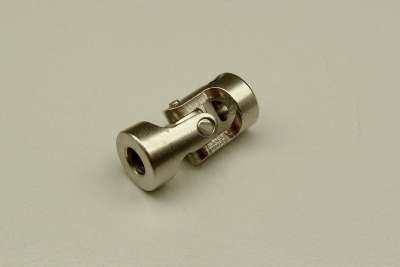
Universal joint or Cardan couplings are frequently used in RC cars and boats when the shafts operate at a significant angle to each other. Through one or more joints, a flexible power transmission is achieved, even with larger alignment deviations.

  • Advantage: High flexibility in shaft offset, robust construction.
  • Disadvantage: Increased noise level, typically more wear on the joints.

Pros and Cons at a Glance

Pros of Shaft Couplings:

  • Vibration and Shock Dampening: In motorized RC models, a suitable coupling reduces disruptive vibrations.
  • Compensation for Misalignment: Minor inaccuracies in assembly can be offset, which increases the lifespan of components.
  • Stability and Safety: By absorbing load spikes, the model can be operated reliably over a longer period.

Cons of Shaft Couplings:

  • Power Limitations: Elastic couplings, in particular, have limits in terms of the maximum transmittable torque.
  • Complexity: Depending on the coupling type, installation and maintenance can be more involved.
  • Higher Cost: High-quality couplings specifically designed for a particular application are more expensive than simple rigid connections.

Selection Criteria

  1. Torque Requirements: Check your motor’s specifications and the maximum load peaks. Choose a coupling that can reliably transmit the required torque.
  2. Size and Space Constraints: Many models have very limited space, so opt for a compact design.
  3. Type of Application: If larger angular misalignments are expected, a universal joint coupling is suitable. For minor misalignments, a tube coupling or a flexible metal bellows coupling may suffice.
  4. Material and Quality: Durable materials such as aluminum, brass, or stainless steel provide a long service life. Make sure the workmanship is precise to avoid imbalance or fitting errors.
  5. Maintenance: Some coupling systems (e.g., universal joint couplings) require occasional lubrication. Keep this in mind when making your decision to manage maintenance effort.

Shaft couplings are an essential component in model building, ensuring precise and efficient transfer of engine power to the desired part. The right choice of coupling type depends on factors such as torque, space constraints, application type, and budget. Flexible or tube couplings are especially well-suited for compensating minor misalignments and vibrations, while universal joint couplings are used for larger angular deviations. Rigid couplings are highly precise but demand perfect alignment and are thus more suitable for specialized use cases.

Anyone who takes the time to compare the different coupling types and analyze the specific requirements of their RC model will benefit from smoother operation, reduced wear, and a longer service life. In combination with a suitable motor, a well-matched gearbox, and correct shaft mounting, you can significantly increase both performance and reliability in model building—ensuring long-term enjoyment without costly repairs or breakdowns.

« show less
Shaft Couplings in Model Building: What You Need to Know Shaft couplings play a crucial role in model building when it comes to efficiently transmitting rotational motion while compensating for mechanical inaccuracies. They are particularly important in RC vehicles, boats, and aircraft models, where they serve as a key component to smoothly transfer engine power to propellers, wheels, or... read more »
Close window
Wellenkupplungen

Shaft Couplings in Model Building: What You Need to Know

Shaft couplings play a crucial role in model building when it comes to efficiently transmitting rotational motion while compensating for mechanical inaccuracies. They are particularly important in RC vehicles, boats, and aircraft models, where they serve as a key component to smoothly transfer engine power to propellers, wheels, or rotors. In this article, you will learn about the different types of shaft couplings, their advantages and disadvantages, and the aspects to consider when choosing the right one

Significance of Shaft Couplings in Model Building

For an RC model to function smoothly, a precise connection between the motor and the drivetrain is essential. Because models often operate in very confined spaces, shaft couplings must be compact, reduce vibrations, and compensate for misalignment. They also help minimize material wear by buffering load spikes, thereby increasing the service life of both the motor and the gearbox.

Types of Shaft Couplings

Rigid Couplings

Rigid couplings transmit torque without any play. They are suitable for applications where shafts are precisely aligned and no compensating movement is required. Since rigid couplings do not tolerate any angular or axial misalignment, they are rarely used in model building—especially not when slight deviations in alignment are present.

  • Advantage: High precision and no torsional give.
  • Disadvantage: No compensation for misalignment, higher risk of damage due to vibrations.

Flexible or Elastically Mounted Couplings

Flexible or elastic couplings often use rubber or silicone components or employ metal spring structures (e.g., metal bellows couplings). These designs allow for a certain amount of offset between the shafts and can dampen vibrations and shocks.

  • Advantage: Compensation of small misalignments, reduction of vibrations.
  • Disadvantage: Lower rigidity and limited torque transmission.

Tube Couplings (Hose Couplings)

Tube couplings, also known as sleeve or hose couplings, are very common in model building. They consist of a flexible tube (often made of rubber, silicone, or another elastic material) connecting two metal sleeves. This design can compensate for minor angular and axial misalignments.

  • Advantage: Cost-effective, easy to install, good vibration damping.
  • Disadvantage: Not suitable for very high torques; poorer-quality versions may wear out quickly.

Universal Joint Couplings (Cardan Couplings)

Universal joint or Cardan couplings are frequently used in RC cars and boats when the shafts operate at a significant angle to each other. Through one or more joints, a flexible power transmission is achieved, even with larger alignment deviations.

  • Advantage: High flexibility in shaft offset, robust construction.
  • Disadvantage: Increased noise level, typically more wear on the joints.

Pros and Cons at a Glance

Pros of Shaft Couplings:

  • Vibration and Shock Dampening: In motorized RC models, a suitable coupling reduces disruptive vibrations.
  • Compensation for Misalignment: Minor inaccuracies in assembly can be offset, which increases the lifespan of components.
  • Stability and Safety: By absorbing load spikes, the model can be operated reliably over a longer period.

Cons of Shaft Couplings:

  • Power Limitations: Elastic couplings, in particular, have limits in terms of the maximum transmittable torque.
  • Complexity: Depending on the coupling type, installation and maintenance can be more involved.
  • Higher Cost: High-quality couplings specifically designed for a particular application are more expensive than simple rigid connections.

Selection Criteria

  1. Torque Requirements: Check your motor’s specifications and the maximum load peaks. Choose a coupling that can reliably transmit the required torque.
  2. Size and Space Constraints: Many models have very limited space, so opt for a compact design.
  3. Type of Application: If larger angular misalignments are expected, a universal joint coupling is suitable. For minor misalignments, a tube coupling or a flexible metal bellows coupling may suffice.
  4. Material and Quality: Durable materials such as aluminum, brass, or stainless steel provide a long service life. Make sure the workmanship is precise to avoid imbalance or fitting errors.
  5. Maintenance: Some coupling systems (e.g., universal joint couplings) require occasional lubrication. Keep this in mind when making your decision to manage maintenance effort.

Shaft couplings are an essential component in model building, ensuring precise and efficient transfer of engine power to the desired part. The right choice of coupling type depends on factors such as torque, space constraints, application type, and budget. Flexible or tube couplings are especially well-suited for compensating minor misalignments and vibrations, while universal joint couplings are used for larger angular deviations. Rigid couplings are highly precise but demand perfect alignment and are thus more suitable for specialized use cases.

Anyone who takes the time to compare the different coupling types and analyze the specific requirements of their RC model will benefit from smoother operation, reduced wear, and a longer service life. In combination with a suitable motor, a well-matched gearbox, and correct shaft mounting, you can significantly increase both performance and reliability in model building—ensuring long-term enjoyment without costly repairs or breakdowns.

1 From 2
No results were found for the filter!
Direct coupling 2 to 3.2 mm
Direktkupplung 2 auf 3,2mm Kupplung zum direkten Verbinden von zwei Wellen. Lieferung komplett mit Madenschrauben. Technische Daten: Gesamtlänge 20 mm Durchmesser A 2 mm Durchmesser B 3,2 mm Außendurchmesser ca. 9 mm
6.95€ *
Brass Insert 1/4 inch
Messing-Einsätze Serie 106 für Kreuzgelenk Anwendung im Modellbau Die Messing-Einsätze von Raboesch (Serie 106) sind die ideale Lösung, um unterschiedliche Wellendurchmesser zuverlässig und flexibel miteinander zu verbinden. In Kombination mit einem Kreuzgelenk (Cardan-Kupplung) ermöglichen sie eine sichere Kraftübertragung auch bei...
4.30€ *
Cardan Coupling Connector
Mit dem Doppelverbinder lassen sich zwei Kardan Kupplungen verbinden. Lieferumfang: 1 Verbindungsstück aus Messing für Raboesch Kupplungen
4.50€ *
Brass Insert 4mm
Brass Insert 4mm
Messing-Einsätze Serie 106 für Kreuzgelenk Anwendung im Modellbau Die Messing-Einsätze von Raboesch (Serie 106) sind die ideale Lösung, um unterschiedliche Wellendurchmesser zuverlässig und flexibel miteinander zu verbinden. In Kombination mit einem Kreuzgelenk (Cardan-Kupplung) ermöglichen sie eine sichere Kraftübertragung auch bei...
4.30€ *
Brass Insert 2mm
Brass Insert 2mm
Messing-Einsätze Serie 106 für Kreuzgelenk Anwendung im Modellbau Die Messing-Einsätze von Raboesch (Serie 106) sind die ideale Lösung, um unterschiedliche Wellendurchmesser zuverlässig und flexibel miteinander zu verbinden. In Kombination mit einem Kreuzgelenk (Cardan-Kupplung) ermöglichen sie eine sichere Kraftübertragung auch bei...
4.30€ *
Brass Insert 2.3mm
Brass Insert 2.3mm
Messing-Einsätze Serie 106 für Kreuzgelenk Anwendung im Modellbau Die Messing-Einsätze von Raboesch (Serie 106) sind die ideale Lösung, um unterschiedliche Wellendurchmesser zuverlässig und flexibel miteinander zu verbinden. In Kombination mit einem Kreuzgelenk (Cardan-Kupplung) ermöglichen sie eine sichere Kraftübertragung auch bei...
4.30€ *
Brass Insert 3mm
Brass Insert 3mm
Messing-Einsätze Serie 106 für Kreuzgelenk Anwendung im Modellbau Die Messing-Einsätze von Raboesch (Serie 106) sind die ideale Lösung, um unterschiedliche Wellendurchmesser zuverlässig und flexibel miteinander zu verbinden. In Kombination mit einem Kreuzgelenk (Cardan-Kupplung) ermöglichen sie eine sichere Kraftübertragung auch bei...
4.30€ *
Brass Insert 5mm
Brass Insert 5mm
Messing-Einsätze Serie 106 für Kreuzgelenk Anwendung im Modellbau Die Messing-Einsätze von Raboesch (Serie 106) sind die ideale Lösung, um unterschiedliche Wellendurchmesser zuverlässig und flexibel miteinander zu verbinden. In Kombination mit einem Kreuzgelenk (Cardan-Kupplung) ermöglichen sie eine sichere Kraftübertragung auch bei...
4.30€ *
Brass Insert 6mm
Brass Insert 6mm
Messing-Einsätze Serie 106 für Kreuzgelenk Anwendung im Modellbau Die Messing-Einsätze von Raboesch (Serie 106) sind die ideale Lösung, um unterschiedliche Wellendurchmesser zuverlässig und flexibel miteinander zu verbinden. In Kombination mit einem Kreuzgelenk (Cardan-Kupplung) ermöglichen sie eine sichere Kraftübertragung auch bei...
4.30€ *
Brass Insert M5
Brass Insert M5
Messing-Einsätze Serie 106 für Kreuzgelenk Anwendung im Modellbau Die Messing-Einsätze von Raboesch (Serie 106) sind die ideale Lösung, um unterschiedliche Wellendurchmesser zuverlässig und flexibel miteinander zu verbinden. In Kombination mit einem Kreuzgelenk (Cardan-Kupplung) ermöglichen sie eine sichere Kraftübertragung auch bei...
4.30€ *
Brass Insert M6
Brass Insert M6
Messing-Einsätze Serie 106 für Kreuzgelenk Anwendung im Modellbau Die Messing-Einsätze von Raboesch (Serie 106) sind die ideale Lösung, um unterschiedliche Wellendurchmesser zuverlässig und flexibel miteinander zu verbinden. In Kombination mit einem Kreuzgelenk (Cardan-Kupplung) ermöglichen sie eine sichere Kraftübertragung auch bei...
4.30€ *
Brass Insert 3.2mm
Brass Insert 3.2mm
Messing-Einsätze Serie 106 für Kreuzgelenk Anwendung im Modellbau Die Messing-Einsätze von Raboesch (Serie 106) sind die ideale Lösung, um unterschiedliche Wellendurchmesser zuverlässig und flexibel miteinander zu verbinden. In Kombination mit einem Kreuzgelenk (Cardan-Kupplung) ermöglichen sie eine sichere Kraftübertragung auch bei...
4.30€ *
Brass Insert M4
Brass Insert M4
Messing-Einsätze Serie 106 für Kreuzgelenk Anwendung im Modellbau Die Messing-Einsätze von Raboesch (Serie 106) sind die ideale Lösung, um unterschiedliche Wellendurchmesser zuverlässig und flexibel miteinander zu verbinden. In Kombination mit einem Kreuzgelenk (Cardan-Kupplung) ermöglichen sie eine sichere Kraftübertragung auch bei...
4.30€ *
Hochlastkupplung 5/4 und 4/3.2
Hochlastkupplung mit D 5/4 auf 4/3.2 mm
19.95€ *
Hochlastkupplung 5 und 5mm
Hochlastkupplung mit D 5 auf 5 mm
19.00€ *
Coupling 2mm / 4mm Alu
Wellenkupplung 2mm / 4mm Alu Graupner ALU Kupplung
5.90€ *
Coupling 6mm / 4mm Alu
Wellenkupplung 6mm / 4mm Alu Graupner ALU Kupplung
6.90€ *
navy Gelenkkupplung Stahl 4/4
Gelenkkupplung Stahl 9xL23mm, Bohrung 4/4
4.90€ *
navy Gelenkkupplung Stahl 3/4
Gelenkkupplung Stahl 9xL23mm, Bohrung 3/4
4.90€ *
navy Gelenkkupplung Stahl 4/5
Gelenkkupplung Stahl 9xL23mm, Bohrung 4/5
4.90€ *
navy Gelenkkupplung Stahl 3,17/4
Gelenkkupplung Stahl 9xL23mm, Bohrung 3,17/4
4.90€ *
ro-navy Gelenkkupplung Stahl 5/5
Gelenkkupplung Stahl 11xL23mm, Bohrung 5/5
4.90€ *
ro-navy Gelenkkupplung Stahl 6/6
Gelenkkupplung Stahl 11xL23mm, Bohrung 6/6
4.90€ *
Coupling 2.3mm / 4mm Alu
Wellenkupplung 2.3mm auf 4mm Graupner ALU Kupplung
5.90€ *
Coupling 3.2mm / 3mm Alu
Wellenkupplung 3.2mm / 3mm Alu Graupner ALU Kupplung
5.90€ *
Coupling 3.2mm / 4mm Alu
Wellenkupplung 3.2mm / 4mm Alu Graupner ALU Kupplung
5.90€ *
Coupling 4mm / 5mm Alu
Wellenkupplung 4mm / 5mm Alu Graupner ALU Kupplung
6.90€ *
Coupling 4mm / 4mm Alu
Wellenkupplung 4mm / 4mm Alu Graupner ALU Kupplung
5.90€ *
Coupling 2mm / 2mm Alu
Wellenkupplung 2mm auf 2mm Graupner ALU Kupplung
5.90€ *
Coupling 2.3mm / 3mm Alu
Wellenkupplung 2.3mm auf 3mm Graupner ALU Kupplung
5.90€ *
Coupling 2.3mm / 2mm Alu
Wellenkupplung 2.3mm auf 2mm Graupner ALU Kupplung
5.90€ *
Navy Kardan 44
Navy Kardan 44
Navy Kardan 44 3,2/4 auf 4 mm Doppel-Kreuzgelenkkupplung für Schiffsantriebe
7.60€ *
Kupplungsschlauch
Kupplungsschlauch
Kupplungsschlauch 5x1,2x50 mm Verbindet Wellen von 1,5 bis 2,5 mm Durchmesser
0.90€ *
Kardan Kreuzgelenk einzeln
Schiffskupplung Kreuzgelenk Kardan Kupplung
8.10€ *
1 From 2
Viewed